Navigating the Jewish 12 months: A Complete Information to the Jewish Vacation Calendar 2026
 The Jewish calendar, a lunisolar system, intricately weaves collectively the cycles of the moon and the solar to create a wealthy tapestry of holidays and observances. In contrast to the Gregorian calendar, which is solely photo voltaic, the Jewish calendar’s dependence on the lunar cycle signifies that Jewish holidays fall on completely different dates annually in accordance with the Gregorian calendar. Understanding the Jewish vacation calendar is crucial for Jewish people and households, in addition to for anybody in search of to know Jewish tradition and custom. This text will present an in depth overview of the Jewish vacation calendar for the yr 2026, exploring the importance, traditions, and historic context of every main vacation.
Understanding the Jewish Calendar
Earlier than delving into the precise dates for 2026, it is essential to know the elemental ideas of the Jewish calendar.
- Lunisolarr System: The Jewish calendar is predicated on each the lunar cycle (months) and the photo voltaic cycle (years). A lunar month is roughly 29.5 days lengthy, and twelve lunar months add as much as about 354 days, which is shorter than a photo voltaic yr (roughly 365.25 days).
- Leap Years: To reconcile the distinction between the lunar and photo voltaic cycles, the Jewish calendar incorporates leap years. A bissextile year, generally known as a Shanah Me’uberet (pregnant yr), happens seven occasions in a 19-year cycle. In a bissextile year, an additional month, Adar II, is added after the common month of Adar. This adjustment ensures that the Jewish holidays stay aligned with the agricultural seasons in Israel, which is vital for holidays like Passover and Sukkot which have agricultural roots.
- Months: The Jewish yr begins within the fall with the month of Tishrei, which is the month of Rosh Hashanah. The months of the Jewish yr are:
- Tishrei
- Cheshvan
- Kislev
- Tevet
- Shevat
- Adar (or Adar I and Adar II in a bissextile year)
- Nissan
- Iyar
- Sivan
- Tammuz
- Av
- Elul
- Days: Jewish days start at sundown and finish at sundown the next day. That is derived from the creation narrative in Genesis, which states, “And there was night, and there was morning, in the future.”
- Figuring out Dates: The exact dedication of the Jewish calendar is advanced and entails calculations primarily based on astronomical observations and established guidelines. Whereas traditionally, the Sanhedrin (Jewish excessive court docket) decided the calendar, right now it’s primarily based on a set system developed by Hillel II within the 4th century CE.
The Jewish Vacation Calendar 2026: A Detailed Overview
The yr 2026 will likely be a daily (non-leap) yr within the Jewish calendar. Here’s a breakdown of the most important Jewish holidays and observances in 2026, together with their significance and customs:
Fall Holidays (Tishrei and Cheshvan)
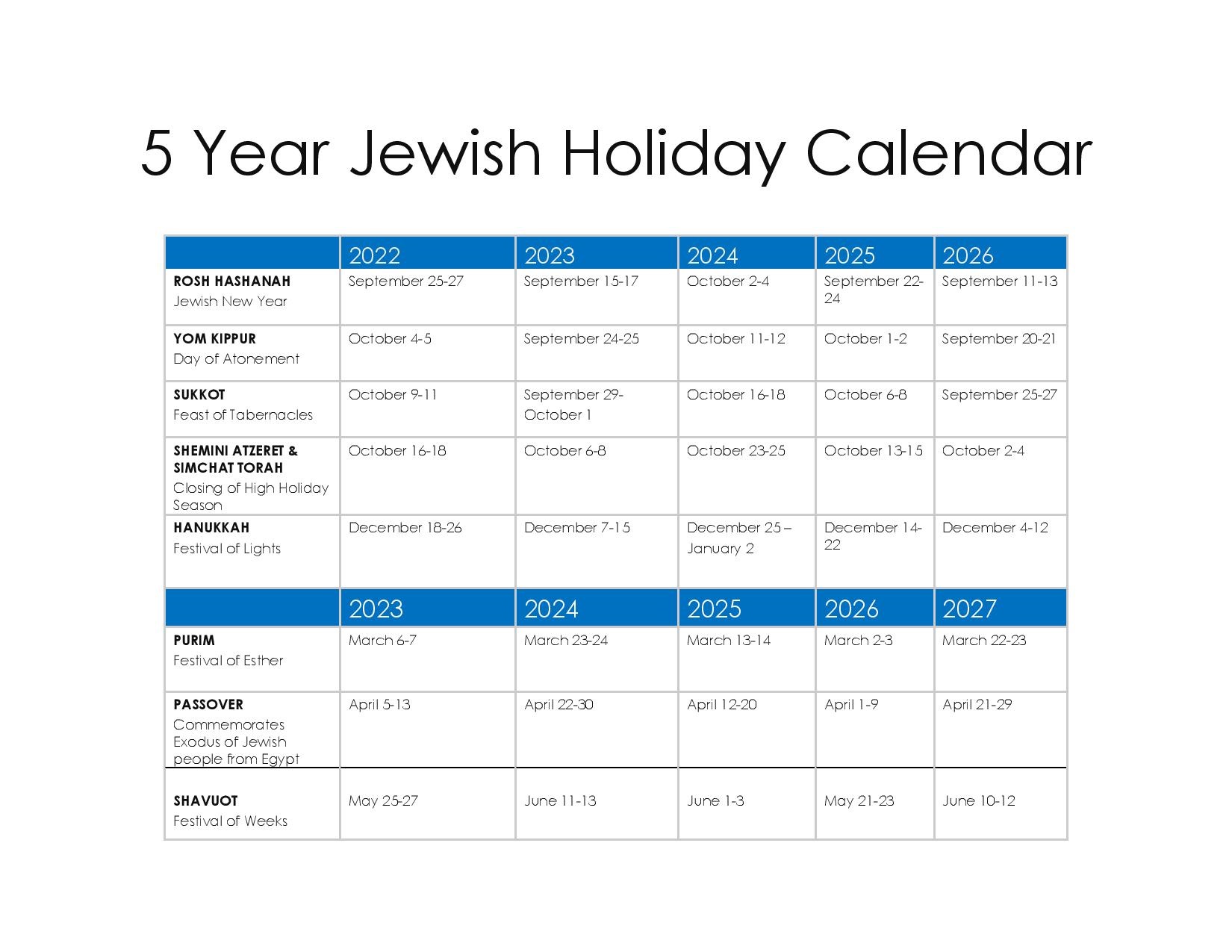
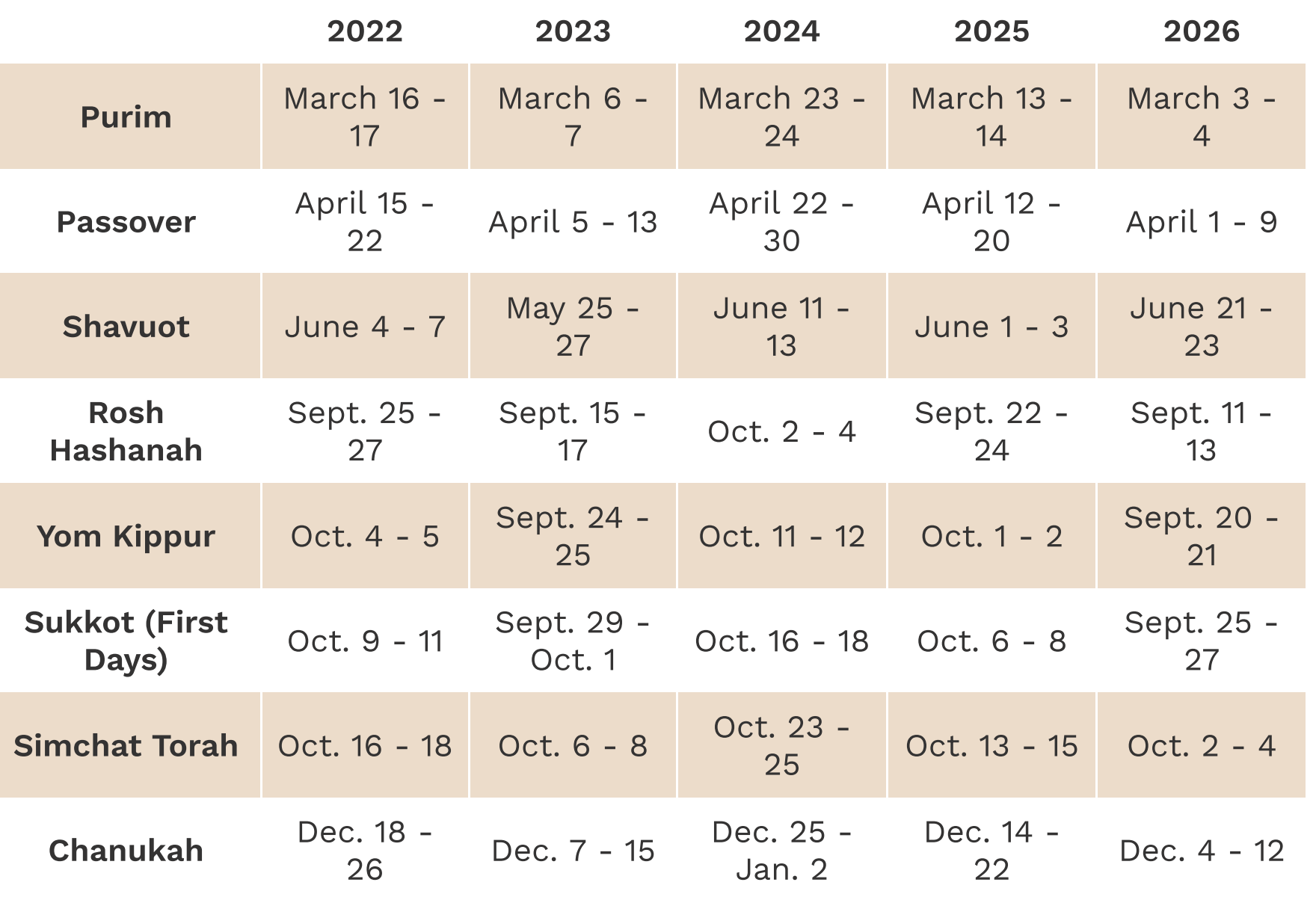
- Rosh Hashanah (Jewish New 12 months): September 12-14, 2026 (1st and 2nd of Tishrei, 5787)
- Significance: Rosh Hashanah marks the start of the Jewish New 12 months. It’s a time of reflection, repentance, and renewal. The vacation commemorates the creation of the world and God’s sovereignty.
- Customs:
- Blowing the Shofar: Essentially the most outstanding customized is the blowing of the shofar (ram’s horn) within the synagogue. The shofar’s blasts are supposed to awaken the soul and name folks to repentance.
- Consuming Symbolic Meals: Apples dipped in honey symbolize a candy new yr. Different conventional meals embody pomegranates (symbolizing abundance) and spherical challah bread (symbolizing the cyclical nature of life).
- Tashlich: A ritual carried out on the afternoon of the primary day of Rosh Hashanah, the place folks symbolically solid their sins right into a physique of water.
- Synagogue Companies: Attending particular synagogue providers is a central a part of the vacation.
- Yom Kippur (Day of Atonement): September 21, 2026 (tenth of Tishrei, 5787)
- Significance: Yom Kippur is the holiest day of the Jewish yr, a day of fasting, prayer, and repentance. It’s a time for in search of forgiveness for sins dedicated throughout the previous yr.
- Customs:
- Fasting: A 25-hour quick is noticed from sundown to sundown.
- Prayer: Spending the day in synagogue, reciting particular prayers of repentance and confession.
- Abstinence: Abstaining from work, bathing, sporting leather-based sneakers, and marital relations.
- Kol Nidre: The solemn prayer recited at first of Yom Kippur providers.
- Sukkot (Feast of Tabernacles): September 26 - October 3, 2026 (Fifteenth-Twenty first of Tishrei, 5787)
- Significance: Sukkot is a week-long competition that commemorates the Israelites’ wandering within the desert after the Exodus from Egypt. It’s also a harvest competition.
- Customs:
- Constructing and Dwelling in a Sukkah: A brief construction, or sukkah, is constructed and embellished. Meals are eaten and, ideally, one sleeps within the sukkah at some point of the vacation. The sukkah symbolizes the short-term dwellings of the Israelites within the desert.
- The 4 Species (Lulav and Etrog): The lulav (palm department) and etrog (citron) are held and waved throughout synagogue providers. These symbolize completely different facets of the Jewish folks and the harvest.
- Simchat Beit Hashoeva: Festive celebrations, usually involving music and dancing, that happen throughout the intermediate days of Sukkot.
- Shemini Atzeret (Eighth Day of Meeting): October 3, 2026 (Twenty second of Tishrei, 5787)
- Significance: Shemini Atzeret is a separate vacation that instantly follows Sukkot. It’s a day of prayer for rain and a time to precise gratitude for the blessings of the previous yr.
- Customs:
- Yizkor: A memorial service for deceased family is recited within the synagogue.
- Prayer for Rain: A particular prayer for rain is recited, marking the start of the wet season in Israel.
- Simchat Torah (Rejoicing of the Torah): October 4, 2026 (twenty third of Tishrei, 5787)
- Significance: Simchat Torah marks the completion of the annual cycle of Torah readings and the start of a brand new cycle.
- Customs:
- Hakafot: Vigorous processions with the Torah scrolls across the synagogue, usually involving singing, dancing, and joyous celebration.
- Studying the Finish and Starting of the Torah: The final portion of Deuteronomy and the primary portion of Genesis are learn, symbolizing the continual cycle of Torah examine.
Winter Holidays (Kislev and Tevet)
- Chanukah (Competition of Lights): December 5-13, 2026 (twenty fifth of Kislev to 2nd or third of Tevet, 5787)
- Significance: Chanukah commemorates the Maccabean revolt in opposition to the Seleucid Empire within the 2nd century BCE and the rededication of the Temple in Jerusalem.
- Customs:
- Lighting the Menorah: Every evening of Chanukah, a further candle is lit on the menorah (Chanukiah) till all eight candles are lit on the ultimate evening.
- Consuming Fried Meals: Meals fried in oil, reminiscent of latkes (potato pancakes) and sufganiyot (jelly-filled doughnuts), are historically eaten to commemorate the miracle of the oil that lasted for eight days.
- Enjoying Dreidel: The dreidel, a four-sided spinning high, is a well-liked Chanukah recreation.
- Giving Presents: Giving presents, particularly to kids, is a standard Chanukah custom.
Spring Holidays (Adar and Nissan)
- Purim (Feast of Tons): March 4, 2026 (14th of Adar, 5786)
- Significance: Purim celebrates the deliverance of the Jewish folks from Haman’s plot to annihilate them in historic Persia, as recounted within the Guide of Esther.
- Customs:
- Studying the Megillah (Scroll of Esther): The story of Purim is learn aloud within the synagogue. When Haman’s identify is talked about, folks usually make noise with noisemakers (graggers) to drown out his identify.
- Giving Mishloach Manot (Presents of Meals): Sending presents of meals to pals and neighbors.
- Giving Matanot L’evyonim (Presents to the Poor): Giving charity to the poor.
- Purim Seudah (Festive Meal): Having fun with a festive meal, usually with costumes and revelry.
- Pesach (Passover): April 3-11, 2026 (Fifteenth-Twenty second of Nissan, 5786)
- Significance: Passover commemorates the Exodus of the Israelites from slavery in historic Egypt.
- Customs:
- Seder: The Seder is a ritual meal that takes place on the primary one or two nights of Passover. The Haggadah (Passover story) is learn, and symbolic meals are eaten to retell the story of the Exodus.
- Consuming Matzah: Unleavened bread (matzah) is eaten as an alternative of bread made with leavening, commemorating the haste with which the Israelites left Egypt.
- Avoiding Chametz: Avoiding all meals containing leavening (chametz) throughout your complete week of Passover.
- Trying to find Chametz (Bedikat Chametz): A ritual seek for chametz is carried out the evening earlier than Passover.
Summer season Holidays (Iyar and Sivan)
- Lag B’Omer: Could 6, 2026 (18th of Iyar, 5786)
- Significance: Lag B’Omer is a minor vacation that falls throughout the counting of the Omer, the 49-day interval between Passover and Shavuot. It commemorates the top of a plague that killed 1000’s of scholars of Rabbi Akiva, a outstanding 2nd-century sage. It’s also related to the anniversary of the dying of Rabbi Shimon bar Yochai, a kabbalistic sage.
- Customs:
- Bonfires: Bonfires are historically lit on Lag B’Omer.
- Haircuts: It’s customary to get haircuts on Lag B’Omer, as haircuts are historically forbidden throughout the Omer interval (besides on sure events).
- Weddings: Weddings are permitted on Lag B’Omer, as they’re typically prohibited throughout the Omer interval.
- Shavuot (Feast of Weeks): Could 23-25, 2026 (sixth and seventh of Sivan, 5786)
- Significance: Shavuot commemorates the giving of the Torah to Moses on Mount Sinai. It’s also a harvest competition, marking the wheat harvest.
- Customs:
- All-Night time Torah Research: It’s customary to remain up all evening studying Torah on the primary evening of Shavuot.
- Studying the Ten Commandments: The Ten Commandments are learn aloud within the synagogue.
- Consuming Dairy Meals: Dairy meals, reminiscent of cheesecake and blintzes, are historically eaten on Shavuot.
- Adorning with Greenery: Synagogues and houses are sometimes embellished with greenery, symbolizing the verdant panorama of Mount Sinai.
Different Observances
Along with the most important holidays, there are a number of different vital observances within the Jewish calendar, together with:
- Tisha B’Av (Ninth of Av): July 23, 2026 (ninth of Av, 5786) – A day of mourning for the destruction of the First and Second Temples in Jerusalem.
- Tu B’Shevat (New 12 months for Bushes): February 2, 2026 (Fifteenth of Shevat, 5786) – A minor vacation celebrating the bushes and the surroundings.
- Quick Days: A number of quick days all year long commemorate historic occasions or durations of mourning.
Conclusion
The Jewish vacation calendar is a wealthy and sophisticated system that gives a framework for Jewish life and observance. Understanding the importance and customs related to every vacation permits people to attach with their heritage, have fun traditions, and mirror on the values and teachings of Judaism. As we look forward to the Jewish yr 2026, could this information function a useful useful resource for navigating the calendar and enriching your understanding of Jewish tradition and custom. By understanding the nuances of the lunisolar calendar and the precise observances of every vacation, you may absolutely recognize the depth and fantastic thing about the Jewish yr.