Mastering 2026: Making a Dynamic and Customizable Calendar in Microsoft Excel
 As we method the yr 2026, the necessity for environment friendly and arranged planning turns into paramount. Whereas digital calendars are ubiquitous, the flexibility and customizability of Microsoft Excel make it a useful instrument for creating personalised calendars tailor-made to particular wants. This text delves into constructing a sturdy and dynamic 2026 calendar in Excel, exploring numerous strategies, formulation, and formatting choices to maximise its performance and aesthetic enchantment.
Why Select Excel for Your 2026 Calendar?
Earlier than diving into the development course of, let’s contemplate some great benefits of utilizing Excel to your 2026 calendar:
- Customization: In contrast to pre-built calendar functions, Excel permits you to tailor the calendar exactly to your necessities. You may customise the structure, add particular fields for monitoring duties, appointments, birthdays, and different essential occasions.
- Flexibility: Excel gives unparalleled flexibility by way of formatting and knowledge manipulation. You need to use conditional formatting to focus on particular dates, apply totally different shade schemes, and combine your calendar with different spreadsheets.
- Integration: Excel seamlessly integrates with different Microsoft Workplace functions and exterior knowledge sources. You may simply import knowledge from different spreadsheets, databases, and even internet pages to populate your calendar.
- Offline Entry: In contrast to cloud-based calendars, your Excel calendar is quickly accessible even with out an web connection. That is significantly helpful for customers who have to entry their schedules whereas touring or in areas with restricted connectivity.
- Value-Effectiveness: Excel is commonly already a part of the Microsoft Workplace suite, eliminating the necessity for extra software program purchases. This makes it an economical resolution for creating personalised calendars.
- Studying Alternative: Constructing an Excel calendar offers a precious alternative to boost your spreadsheet abilities and find out about numerous formulation and capabilities.
Constructing Your 2026 Calendar: A Step-by-Step Information
Let’s embark on the method of making a purposeful and visually interesting 2026 calendar in Excel. We’ll begin with a fundamental month-to-month structure after which discover methods to boost its performance and customise its look.
1. Setting Up the Fundamental Month-to-month Structure:
-
Open a New Excel Workbook: Launch Microsoft Excel and create a brand new clean workbook.
-
Outline the Yr: In a cell (e.g., A1), enter the yr “2026”. This may function a reference level for our formulation.
-
Create Month Headers: In row 3, ranging from column B, enter the names of the months: “January”, “February”, “March”, and so forth, as much as “December”.
-
Decide the Beginning Day of the Week: That is essential for correct date placement. In a cell (e.g., A2), use the next method to find out the day of the week for January 1st, 2026:
=WEEKDAY(DATE(A1,1,1),2)This method makes use of the
DATEoperate to create a date object for January 1st, 2026 (utilizing the yr from cell A1). TheWEEKDAYoperate then returns a quantity representing the day of the week (1 for Monday, 2 for Tuesday, and so forth). -
Create Day of the Week Headers: In row 5, ranging from column B, enter the abbreviations for the times of the week: “Solar”, “Mon”, “Tue”, “Wed”, “Thu”, “Fri”, “Sat”.
-
Populate the Dates for January: That is the place the formulation come into play. We’ll begin with January after which replicate the logic for different months.
-
In cell B6, enter the method:
=IF(WEEKDAY(DATE(A1,1,1),2)=1,1,IF(COLUMN(B6)-COLUMN($B$5)+1>=WEEKDAY(DATE(A1,1,1),2),COLUMN(B6)-COLUMN($B$5)+2-WEEKDAY(DATE(A1,1,1),2),"" ))This method checks if January 1st is a Monday. Whether it is, it enters “1” in cell B6. In any other case, it calculates the proper date based mostly on the day of the week of January 1st and the column quantity. If the calculated date is lower than 1, it shows an empty string ("").
-
Drag the method from cell B6 throughout to H6 (representing Sunday).
-
In cell B7, enter the method:
=IF(H6="", "", IF(H6+1<=DAY(EOMONTH(DATE(A1,1,1),0)),H6+1,""))This method checks if the earlier cell (H6) is empty. Whether it is, it shows an empty string. In any other case, it provides 1 to the earlier cell’s worth and checks if the result’s lower than or equal to the final day of January (utilizing the
DAYandEOMONTHcapabilities). Whether it is, it shows the end result; in any other case, it shows an empty string. -
Drag the method from cell B7 throughout to H7.
-
Proceed this sample for rows 8, 9, 10, and 11, adjusting the references to the earlier row accordingly. Bear in mind to regulate the method in B8, B9, B10, and B11 to discuss with the cell within the earlier row (e.g., H7, H8, H9, H10) as a substitute of H6.
-
2. Replicating for Different Months:
- Copy and Paste: Choose the cells containing the January calendar (B5:H11). Copy these cells.
- Paste for Subsequent Months: Paste the copied cells into the corresponding columns for February (I5:O11), March (P5:V11), and so forth, as much as December (BW5:CC11).
- Modify Formulation for Every Month: The formulation in every month have to be adjusted to replicate the proper month. That is probably the most tedious half however essential for accuracy. You may want to alter the month quantity within the
DATEoperate inside every method. For instance, for February, changeDATE(A1,1,1)toDATE(A1,2,1). Repeat this for all formulation in every month.
3. Dynamic Yr and Month Choice:
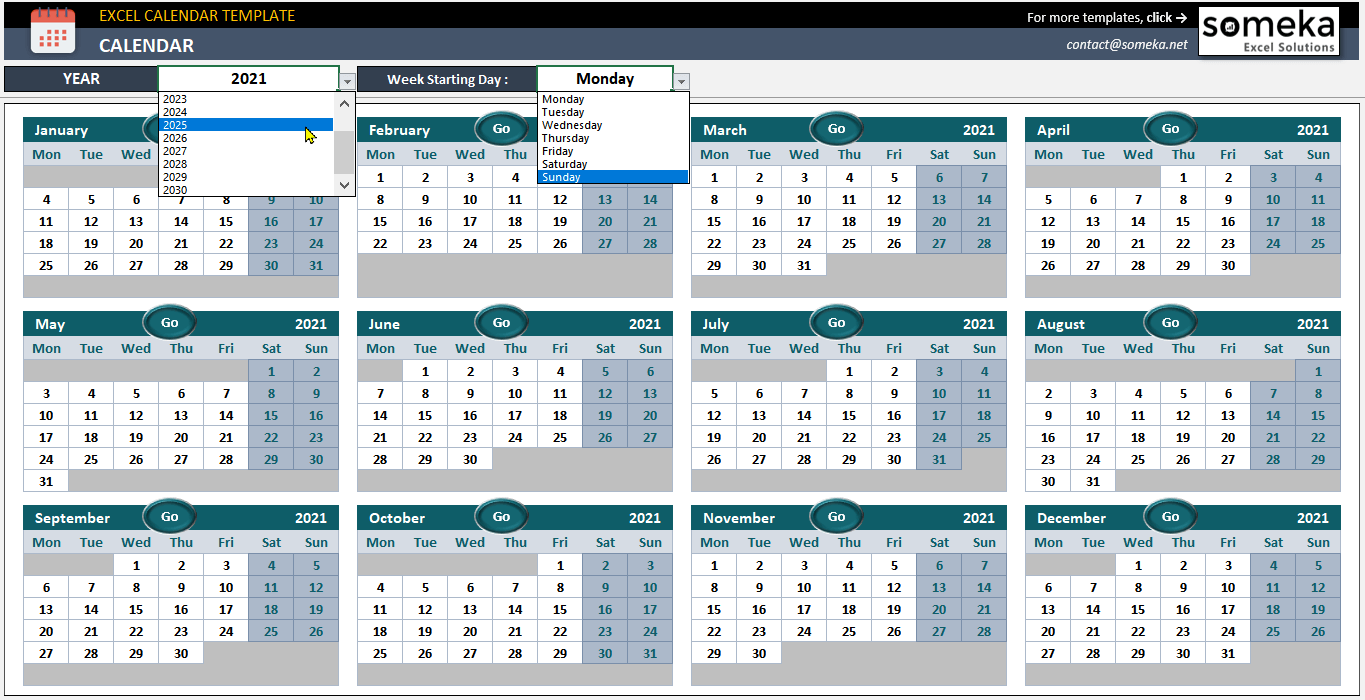
- Yr Dropdown: As an alternative of manually getting into the yr in A1, create a dropdown listing.
- Go to the “Information” tab.
- Click on on “Information Validation.”
- Within the “Settings” tab, select “Record” from the “Enable” dropdown.
- Within the “Supply” subject, enter a spread of years (e.g., “2020,2021,2022,2023,2024,2025,2026,2027,2028”) or discuss with a spread of cells containing the years.
- Click on “OK.” Now you’ll be able to choose the yr from a dropdown listing.
- Month Dropdown (Elective): If you wish to show just one month at a time, you’ll be able to create a dropdown for choosing the month. This requires vital modifications to the formulation to dynamically alter the calendar based mostly on the chosen month. It is a extra superior function and past the scope of this fundamental information.
4. Enhancing Performance: Including Occasions and Reminders
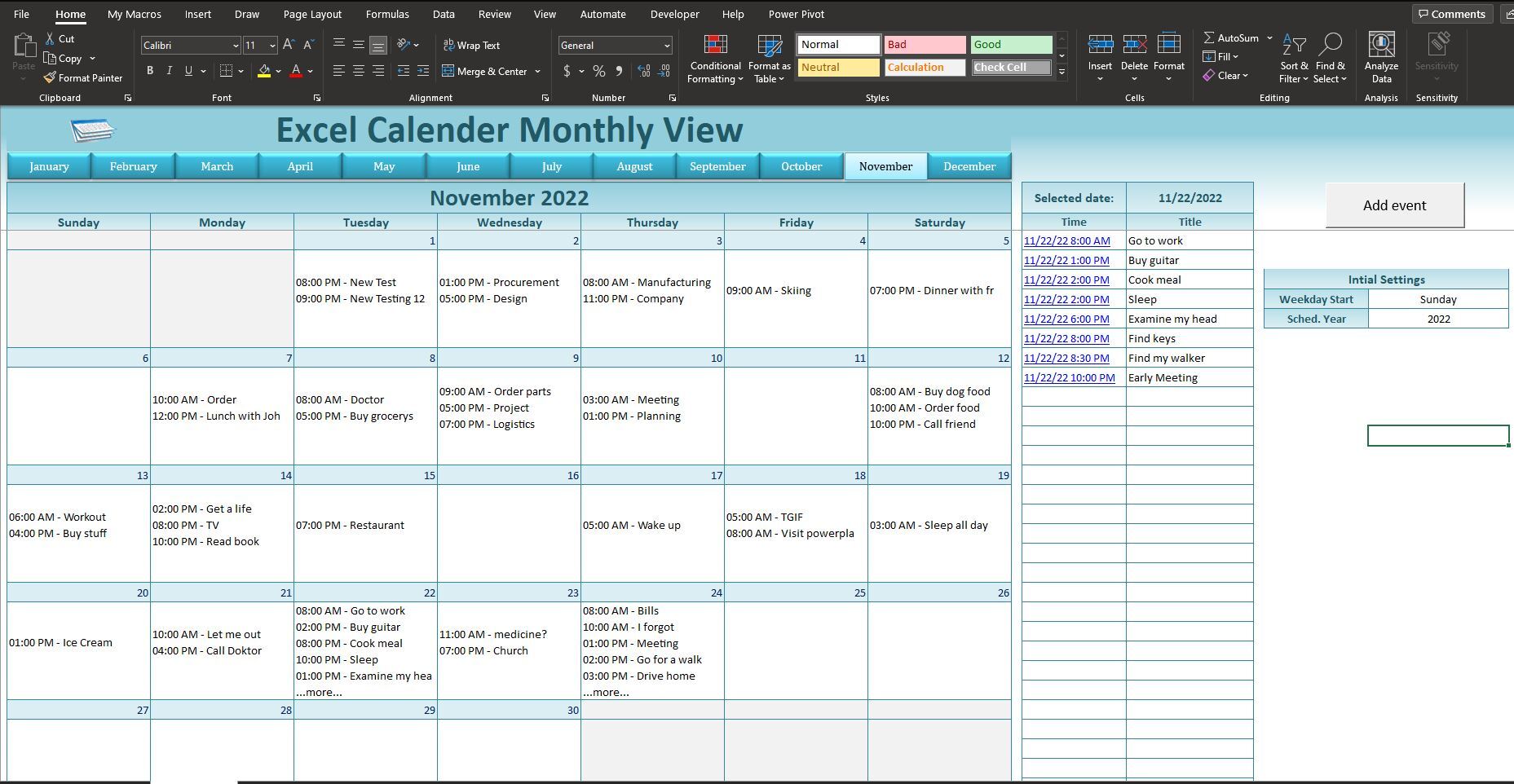
- Occasion Monitoring: Add additional rows under every month’s calendar to trace occasions. For instance, add two rows for every month and label them “Occasion 1” and “Occasion 2”. Customers can then enter occasion descriptions in these cells.
- Conditional Formatting for Holidays: Create a listing of holidays for 2026 in a separate sheet. Then, use conditional formatting to focus on these dates in your calendar.
- Choose the cells containing the dates in your calendar.
- Go to the “Dwelling” tab and click on on “Conditional Formatting.”
- Select “New Rule.”
- Choose “Use a method to find out which cells to format.”
- Enter a method like
=COUNTIF(Holidays!$A$1:$A$10,DATE(A1,1,B6))>0(exchange “Holidays!$A$1:$A$10” with the precise vary containing your vacation dates, and alter the month quantity (1) and cell reference (B6) accordingly for every month). - Click on “Format” and select the specified formatting (e.g., background shade).
- Click on “OK” twice.
5. Customizing the Look:
- Formatting Cells: Use the formatting choices within the “Dwelling” tab to alter the font, dimension, shade, and alignment of the textual content in your calendar.
- Including Borders: Add borders to the cells to create a visually interesting grid.
- Colour Schemes: Experiment with totally different shade schemes to personalize your calendar. Use the “Fill Colour” and “Font Colour” choices to create a cohesive look.
- Adjusting Column Widths and Row Heights: Modify the column widths and row heights to optimize the structure of your calendar.
- Freezing Panes: Freeze the highest row (containing the month headers) and the primary column (containing the day of the week headers) to maintain them seen as you scroll by means of the calendar. Go to the “View” tab and click on “Freeze Panes.”
Superior Methods (Past the Fundamentals):
- Utilizing Named Ranges: Assign names to cells or ranges of cells which can be ceaselessly utilized in formulation. This makes the formulation simpler to grasp and preserve.
- Making a Consumer Interface with VBA: For extra superior customization, you need to use VBA (Visible Fundamental for Purposes) to create a person interface with buttons and controls for navigating the calendar and including occasions.
- Integrating with Outlook or Google Calendar: Whereas Excel would not straight combine with these platforms, you’ll be able to export your Excel calendar as a CSV file and import it into Outlook or Google Calendar.
Troubleshooting Ideas:
- Components Errors: Double-check your formulation for typos and incorrect cell references. Use the “Consider Components” instrument within the “Formulation” tab to step by means of the calculation of a method and determine the supply of the error.
- Incorrect Dates: Be certain that the beginning day of the week is calculated appropriately and that the formulation for every month are adjusted accordingly.
- Formatting Points: Clear any undesirable formatting by choosing the cells and clicking “Clear Codecs” within the “Dwelling” tab.
Conclusion:
Making a 2026 calendar in Microsoft Excel offers a strong and versatile option to handle your schedule and keep organized. By mastering the strategies and formulation outlined on this article, you’ll be able to construct a customized calendar that meets your particular wants and preferences. Whereas the preliminary setup might sound daunting, the advantages of getting a completely customizable and built-in calendar are properly well worth the effort. Bear in mind to observe and experiment with totally different options to unlock the complete potential of Excel for calendar administration. Good luck planning your 2026!